Meeting the Cajon: A Wooden Box That Sings
History, construction, and why a wooden box can make so many sounds
You might be opening this chapter for one of three reasons:
- You want to learn a new instrument, but worry the bar is too high — sticks, drumheads, tuning: it all sounds expensive;
- You've seen a street performer slapping a wooden box and wondered where that sound comes from;
- You already play, but have been copying by ear and want to understand "why it's played this way".
Whichever it is, this chapter gives you a solid starting point. The cajon may be one of the lowest-barrier instruments in the world: a box, two hands, sit down and it sounds.
Where the cajon comes from
The cajon (Cajón, "box" in Spanish) originated in 19th-century Peru. Enslaved Africans were banned from using their own drums, so they turned shipping crates (slat boxes for fish or fruit) into instruments: sit on the box, strike the front face with both hands. This "forced invention" survived, was later brought to Europe by Spanish flamenco musicians, became the standard percussion instrument of flamenco, and spread to pop, folk, and Latin stages worldwide.
Remember its story in one line: a people whose drums were banned played their own rhythm on fruit crates.
Why one box makes so many sounds
The cajon's construction is extremely simple, but every part has a clear job:
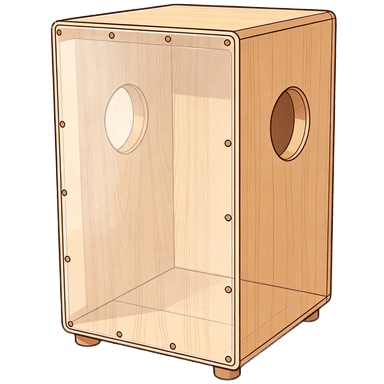
| Part | Job |
|---|---|
| Face (Tapa) | The striking surface on the front, usually a thin wood (birch, mahogany), determines tonal sensitivity |
| Body | The resonance chamber that amplifies the face's vibration |
| Sound hole (back) | The round port that fattens the low end and makes the sound more "open" |
| Snare wires | Strings or plastic strips on the inside of the face, producing the snare-like "rattle"; tension affects slap brightness — start with the factory setting |
The principle is simple: you strike the face, the face vibrates, the body resonates and amplifies, the sound hole sends it out. A bigger and thinner face gives a softer, deeper bass; a stiffer face with tighter snare wires gives a sharper, brighter slap.
Three basic tones, from your very first note
This tutorial's notation system has five marks and three tones:
- B (Bass): heel of the palm just below the center of the face — deep and solid, like a "Dum", the "foundation" of the rhythm;
- S (Slap): fingers together on the upper corner edge — bright and sharp, like a "Tah";
- s (Ghost note): fingers touch the face lightly, almost no force — barely there, like a heartbeat in the background.
The core rule to remember: the closer to the center of the face you strike, the lower the sound; the closer to the edge, the higher. Chapter 2 will take you through all three tones one by one.
What you take away from this chapter
- The cajon is a box-shaped instrument from Peru, invented by enslaved Africans whose drums were banned;
- The sound chain is "face vibrates → body resonates → sound hole sends it out";
- Three basic tones B/S/s, arranged by the "low in the middle, high at the edge" principle.
Next chapter, we sit down at the drum and — starting with posture and hand shape — actually play the three tones.